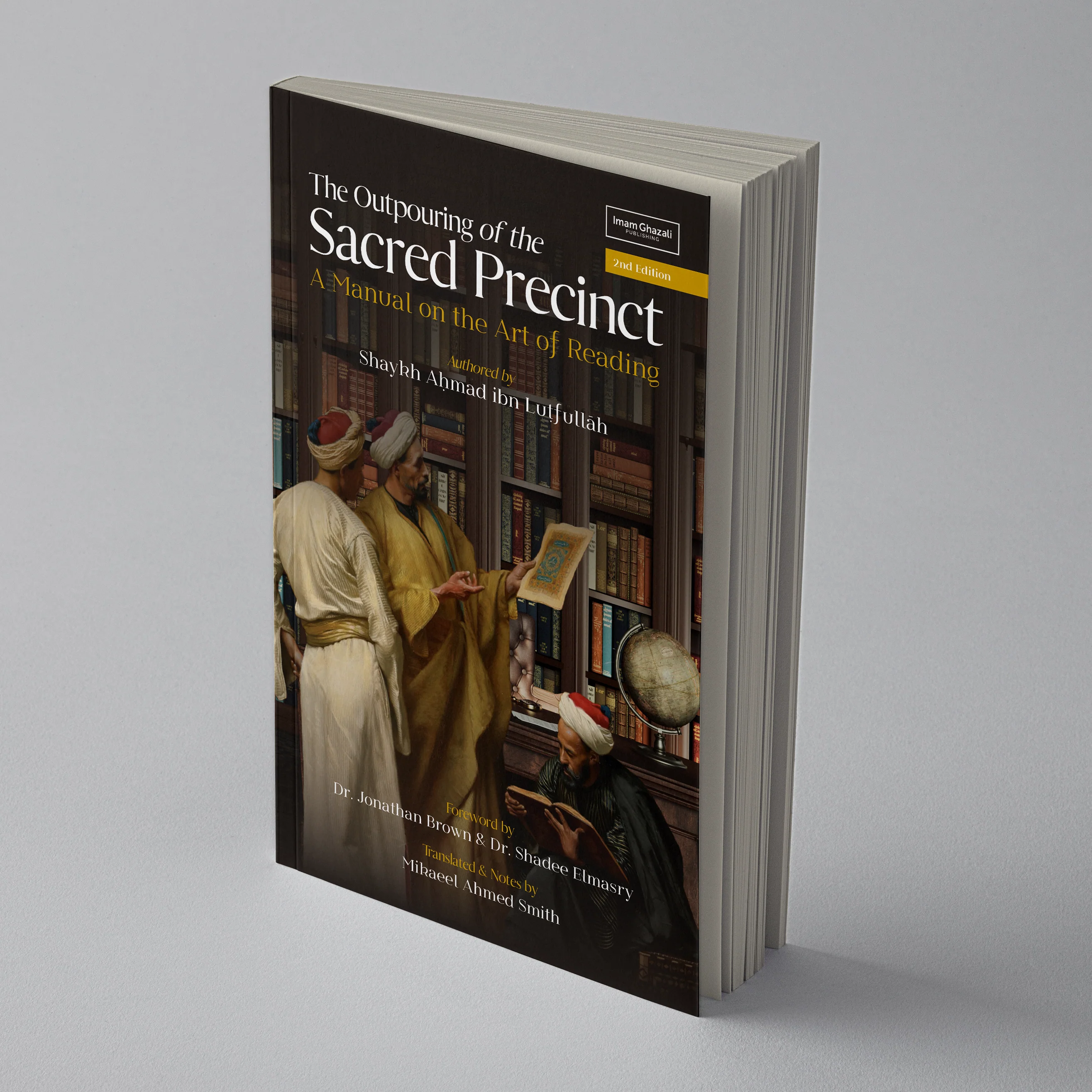
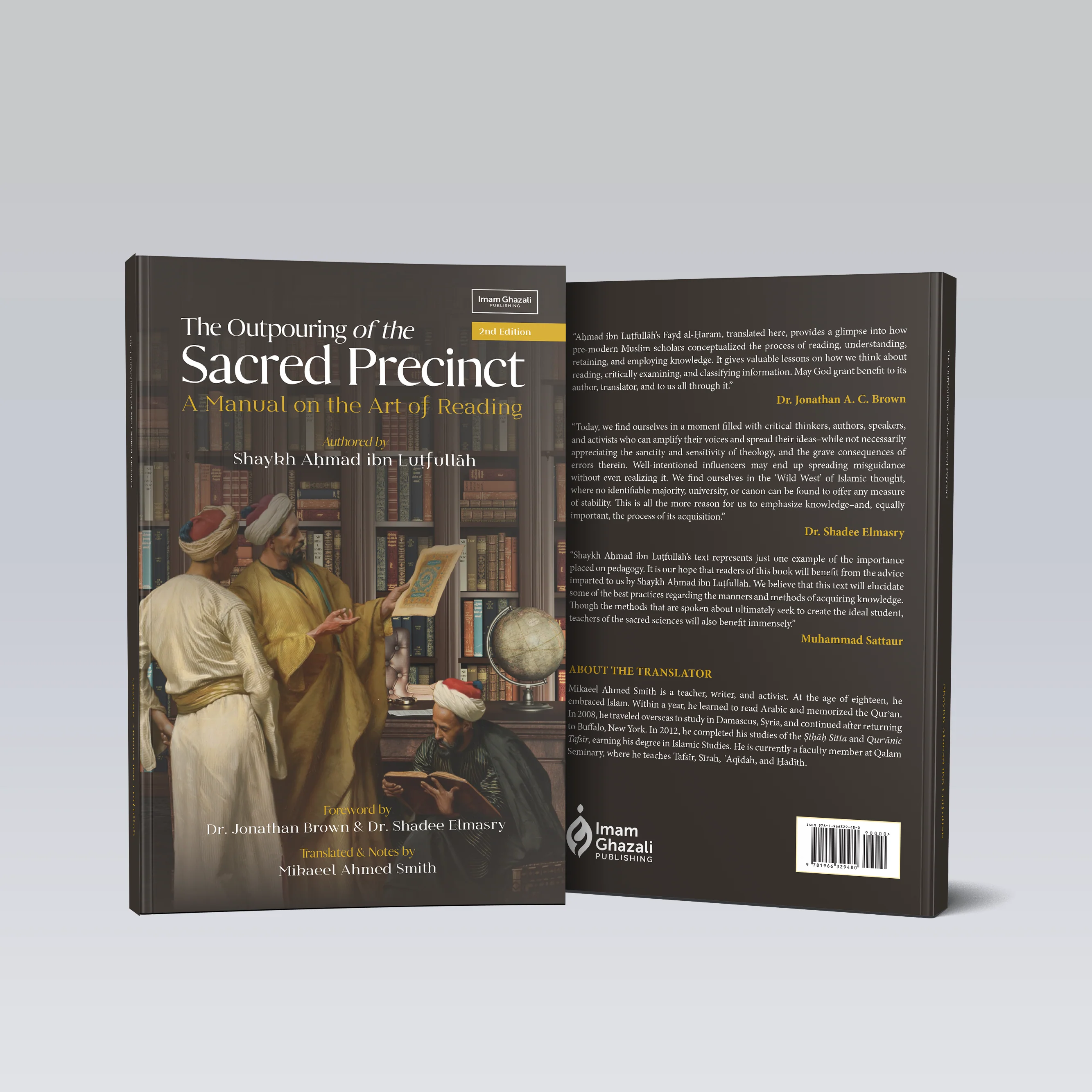
The Outpouring of the Sacred Precinct
How does one truly read a sacred text? How can a student without access to teachers verify their understanding? What distinguishes surface reading from deep comprehension?
In the year 1691, Shaykh Ahmad ibn Lutfullah sat before the Kaaba and penned answers to these perennial questions. A polymath who served as Chief Astronomer to Sultan Mehmed IV, the author drew upon decades of scholarship across multiple disciplines to produce this systematic guide to the art of reading.
The Outpouring of the Sacred Precinct (Fayd al-Haram) is an important work within the Islamic intellectual tradition. While numerous classical works address the spiritual and ethical dimensions of seeking knowledge, few systematically analyse the cognitive processes involved in deep reading. The author breaks down the act of study into its constituent elements: understanding individual words, grasping grammatical structures, recognising rhetorical devices, identifying logical arguments, and synthesising complex meanings into coherent understanding.
Written for the student of knowledge, one who has grasped introductory concepts but has not yet achieved scholarly mastery, this work provides practical tools for those who find themselves between elementary instruction and advanced scholarship. The author offers precise guidance on how to know when true understanding has been achieved, how to distinguish superficial comprehension from genuine insight, and how to extract meanings from texts without direct teacher supervision.
This second edition has been completely revised with improved translation, standardised transliteration, and enhanced Arabic.
The need for this work has never been greater. In an age of abundant information and fractured attention, Shaykh Ahmad's systematic approach offers a methodology for reclaiming depth in reading and authenticity in learning.
"Students often move from one idea to the next, even with only the smallest amount of association between the two ideas."
Shaykh Ahmad ibn Lutfullah, 1691Five Sections, One Method
Shaykh Ahmad maps the seeker's path through five distinct stages of study, each with its own etiquettes and tools. Together they form a complete system for reading.
The General Etiquettes for All Researchers and Students
The foundation. How to approach any text in any discipline. Pronunciation, individual words, sentence structure, rhetoric, and logic, in sequence.
For Those Who Intend to Gain Practical Knowledge
When imitation suffices and when it does not. How the student should restrict themselves to one topic until it is solid before moving on.
For One Seeking Verifiable Knowledge Based on Proofs
How to recognise and weigh the different types of evidence: rational, traditional, transmitted, analogical. How to test a proof against its premises.
For One Whose Intention Is Retention by Repetition
How to repeat a text so that each pass produces a new benefit, in wording or in meaning, until the knowledge is firm in the mind.
For One Whose Intention Is to Increase or Strengthen Knowledge
How to grow your understanding by drawing on multiple sources, debating yourself when no teacher is present, and seeking out scholars across continents.
The Intermediate Student
"That student who is gradually proceeding through the stages of perfection by increasing in his studies day by day, little by little. This is what is intended by the term, intermediate student, or one who is between the beginner and the expert."
Two Scholars on Why This Book Matters
"A glimpse into how pre-modern Muslim scholars conceptualised the process of reading, understanding, retaining, and employing knowledge. Valuable across the centuries that separate us from its author."
"This text offers guidance for a situation in which many students of knowledge find themselves today. Namely, reading works in the shariah sciences without access to teachers."
Edition Details
Description
How does one truly read a sacred text? How can a student without access to teachers verify their understanding? What distinguishes surface reading from deep comprehension?
In the year 1691, Shaykh Ahmad ibn Lutfullah sat before the Kaaba and penned answers to these perennial questions. A polymath who served as Chief Astronomer to Sultan Mehmed IV, the author drew upon decades of scholarship across multiple disciplines to produce this systematic guide to the art of reading.
The Outpouring of the Sacred Precinct (Fayd al-Haram) is an important work within the Islamic intellectual tradition. While numerous classical works address the spiritual and ethical dimensions of seeking knowledge, few systematically analyse the cognitive processes involved in deep reading. The author breaks down the act of study into its constituent elements: understanding individual words, grasping grammatical structures, recognising rhetorical devices, identifying logical arguments, and synthesising complex meanings into coherent understanding.
Written for the student of knowledge, one who has grasped introductory concepts but has not yet achieved scholarly mastery, this work provides practical tools for those who find themselves between elementary instruction and advanced scholarship. The author offers precise guidance on how to know when true understanding has been achieved, how to distinguish superficial comprehension from genuine insight, and how to extract meanings from texts without direct teacher supervision.
This second edition has been completely revised with improved translation, standardised transliteration, and enhanced Arabic.
The need for this work has never been greater. In an age of abundant information and fractured attention, Shaykh Ahmad's systematic approach offers a methodology for reclaiming depth in reading and authenticity in learning.
"Students often move from one idea to the next, even with only the smallest amount of association between the two ideas."
Shaykh Ahmad ibn Lutfullah, 1691Five Sections, One Method
Shaykh Ahmad maps the seeker's path through five distinct stages of study, each with its own etiquettes and tools. Together they form a complete system for reading.
The General Etiquettes for All Researchers and Students
The foundation. How to approach any text in any discipline. Pronunciation, individual words, sentence structure, rhetoric, and logic, in sequence.
For Those Who Intend to Gain Practical Knowledge
When imitation suffices and when it does not. How the student should restrict themselves to one topic until it is solid before moving on.
For One Seeking Verifiable Knowledge Based on Proofs
How to recognise and weigh the different types of evidence: rational, traditional, transmitted, analogical. How to test a proof against its premises.
For One Whose Intention Is Retention by Repetition
How to repeat a text so that each pass produces a new benefit, in wording or in meaning, until the knowledge is firm in the mind.
For One Whose Intention Is to Increase or Strengthen Knowledge
How to grow your understanding by drawing on multiple sources, debating yourself when no teacher is present, and seeking out scholars across continents.
The Intermediate Student
"That student who is gradually proceeding through the stages of perfection by increasing in his studies day by day, little by little. This is what is intended by the term, intermediate student, or one who is between the beginner and the expert."
Two Scholars on Why This Book Matters
"A glimpse into how pre-modern Muslim scholars conceptualised the process of reading, understanding, retaining, and employing knowledge. Valuable across the centuries that separate us from its author."
"This text offers guidance for a situation in which many students of knowledge find themselves today. Namely, reading works in the shariah sciences without access to teachers."